Introduction: From Ingenuity to Heavy-Lift Rotorcraft
Just over three years after NASA's Ingenuity helicopter concluded its history-making mission on Mars, engineers at the Jet Propulsion Laboratory (JPL) in California are celebrating a critical breakthrough in rotor technology. This advance will enable the next generation of Martian rotorcraft to carry significantly heavier payloads and travel farther distances through the planet's thin, carbon dioxide-rich atmosphere. The new designs build directly on the lessons learned from Ingenuity, which proved that powered flight on another world is not only possible but also a game-changing exploration tool.
The Legacy of Ingenuity
Ingenuity was a stunning success. Originally envisioned as a technology demonstration of just five flights over 30 days, the small, dual-bladed helicopter ultimately performed 72 flights across the Jezero Crater. It arrived at Mars tucked under the belly of the Perseverance rover, and by the time its mission ended with a crash landing in January 2024, it had completely rewritten the playbook for planetary science.
Thanks to Ingenuity, scientists now recognize that rotorcraft can access locations unreachable by ground vehicles—such as steep cliffs, deep craters, and rugged highlands—while covering greater distances in a fraction of the time. The little helicopter's endurance and capability far exceeded everyone's expectations, but it also highlighted the severe constraints of Mars' low-density atmosphere, which is only about 1% as dense as Earth's. To lift heavier scientific instruments, larger samples, or even small rovers, rotor technology must evolve.
The Breakthrough: Advanced Rotor Blade Design
JPL engineers have now identified a new rotor blade geometry and composite material that dramatically improves aerodynamic efficiency in the thin Martian air. The breakthrough combines:
- Curved, swept-tip blades that reduce drag while maintaining lift at low Reynolds numbers.
- Ultra-light carbon-fiber composites reinforced with a novel lattice structure to increase stiffness without adding weight.
- Distributed electric motor control that allows individual blade pitch adjustment in real time, compensating for sudden wind gusts and density variations.
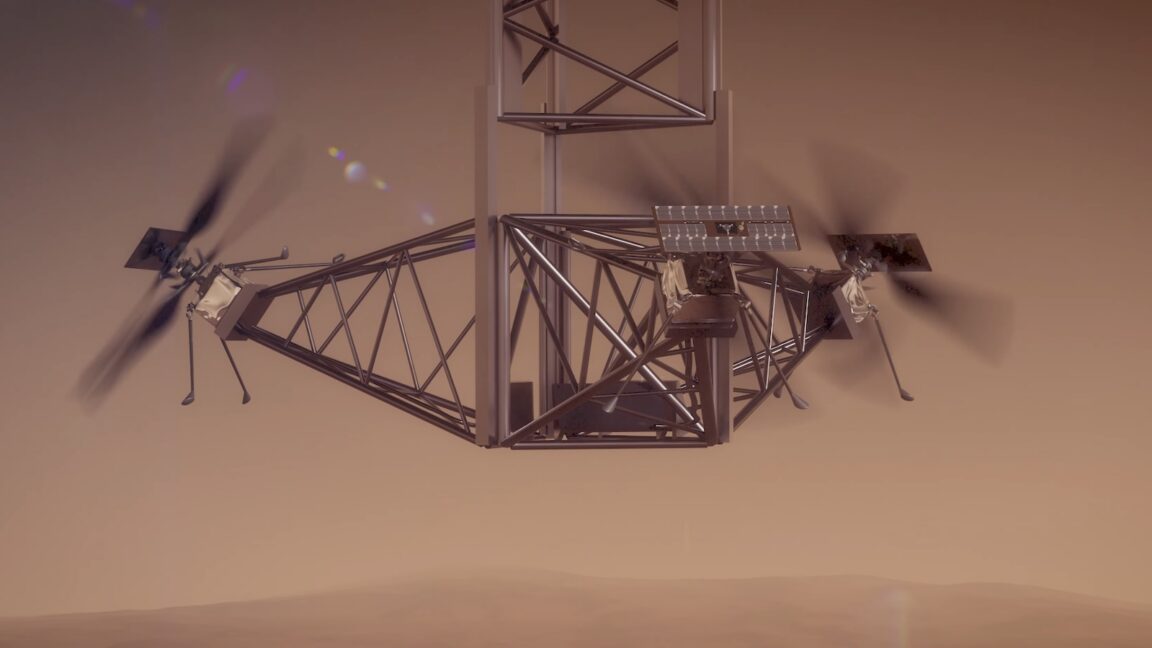
These advances are expected to allow a next-generation Mars helicopter to carry up to five kilograms of payload—more than ten times what Ingenuity could manage—while flying at altitudes of up to 2,000 meters above the Martian surface. The new rotors also spin at a higher RPM, generating enough lift to support a wider fuselage and larger solar arrays, enabling extended flights across several kilometers.
From Demonstration to Mission: The SkyFall Project
NASA is already planning to put this breakthrough into practice. The SkyFall mission, which could launch as soon as late 2028, will send not one but three advanced helicopters to the Red Planet. Each rotorcraft will be equipped with the new blade technology, along with upgraded avionics and autonomous navigation systems.
SkyFall will ride to Mars aboard an innovative nuclear-powered spacecraft designated Space Reactor-1 (SR-1)—one of the technology demonstration projects announced earlier this year by NASA Administrator Jared Isaacman. SR-1 will provide both propulsion and abundant power for the helicopters during their journey and after arrival. The nuclear power source will also allow the rotorcraft to operate through the long, dark Martian winter, significantly extending their operational life.
Mission Objectives
The three SkyFall helicopters will have distinct roles:
- Survey Scout: A high-speed reconnaissance craft that will map terrain ahead of future human missions, identifying safe landing zones and resource-rich areas.
- Sample Retrieval: Equipped with a robotic arm and sample container, this rotorcraft will collect soil and rock samples from scientifically promising sites and ferry them to a central cache.
- Heavy-Lift Cargo: The largest of the three, capable of transporting small science instruments, weather stations, and even replacement parts for surface infrastructure.
The helicopters will coordinate autonomously, sharing data via a mesh network and using Ingenuity's flight algorithms as a foundation. JPL engineers have already started integrating the new rotor system into the SkyFall airframes.
Looking Ahead: The Future of Martian Aviation
Beyond SkyFall, the rotor breakthrough opens the door to even more ambitious concepts. NASA studies are examining mid-air refueling capabilities using stored Mars ice as a hydrogen source, and winged rotorcraft that combine helicopter lift with fixed-wing efficiency for long-range surveys. The knowledge gained from Ingenuity and SkyFall will be essential for designing the first aircraft to fly in the atmospheres of Venus or Saturn's moon Titan.
For now, JPL's engineers are focused on testing the new rotor blades at high altitude on Earth—in vacuum chambers and on mountaintops—to simulate Martian conditions. The first full-scale prototype is expected to perform tethered flights at JPL's facility later this year. If successful, the SkyFall mission will mark the beginning of a new era of aerial exploration on Mars, proving that the sky is no longer the limit when it comes to unraveling the secrets of the Red Planet.
— Based on information originally reported by NASA and the Jet Propulsion Laboratory.