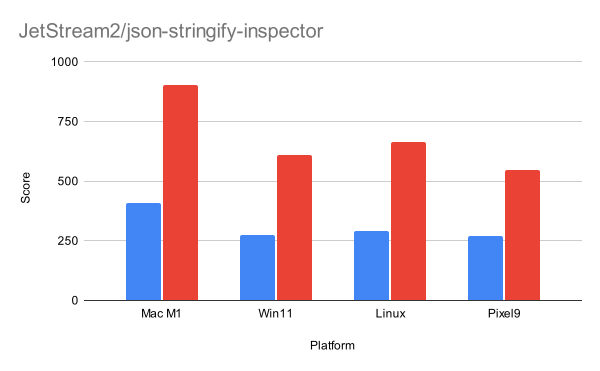
JavaScript’s JSON.stringify is a workhorse, converting objects into strings for everything from API calls to local storage. When V8, the engine powering Chrome and Node.js, made this core function over twice as fast, it was a big deal for web performance. The improvements came from rethinking fundamental design choices: a streamlined, side-effect-free fast path, an iterative instead of recursive architecture, and clever handling of different string encodings. Below, we break down the key questions about how V8 achieved this speed boost and what it means for your code.
What was the key optimization behind the faster JSON.stringify?
The cornerstone of the speedup is a side-effect-free fast path. Normally, the serializer must constantly check whether any operation triggers a side effect—like running user code or even subtle internal actions that could cause garbage collection. V8 identified that if it can guarantee serialization won't have side effects, it can use a highly specialized, much faster implementation. This new fast path bypasses numerous expensive checks and defensive logic that the general-purpose serializer requires. By restricting this optimized route to objects that represent plain data (no custom toJSON methods, no getters, no Proxy objects), V8 safely takes a shortcut that dramatically reduces overhead for the most common use cases.
How does the fast path avoid side effects during serialization?
V8 determines side-effect-freedom by analyzing the object's structure. It checks for anything that could break the simple, linear traversal: user-defined toJSON functions, getters, Proxy traps, or even internal string representations (like ConsString) that might trigger a garbage collection when flattened. As long as none of these are present, V8 stays on the optimized path. This means it can skip all the safeguards needed for unpredictable code, dramatically reducing CPU time. For more details on what exactly triggers side effects, see Limitations and Impact.
Why is an iterative approach better than recursive for serialization?
The old serializer was recursive, which meant each nested object added a call to the stack. This limited depth and required stack overflow checks. The new fast path is iterative, using an explicit stack managed by V8. This architectural change brings two big wins. First, it eliminates the cost of stack overflow checks, saving time on every call. Second, it makes resuming after encoding changes (e.g., switching between different string encodings) much simpler and faster. Most importantly, it allows developers to serialize significantly deeper object graphs without hitting recursion limits—a practical improvement for complex data structures.
How does V8 handle different string representations (one-byte vs. two-byte)?
Strings in V8 come in two flavors: one-byte (ASCII characters, 1 byte per character) and two-byte (any non-ASCII character forces the whole string to use 2 bytes per character). The original serializer had to constantly branch and check which type it was dealing with. To avoid this overhead, V8 now templatizes the entire stringifier on the character type. This means two distinct, specialized versions of the serializer are compiled: one fully optimized for one-byte strings, another for two-byte strings. During serialization, once V8 knows the string type, it dispatches to the correct version, eliminating runtime type checks inside the hot loop.
What are the trade-offs of the templatized approach?
The main downside is an increase in binary size. Compiling two separate serializer variants adds code to V8's compiled output. However, the V8 team judged the performance gain to be worth the extra bytes. For typical JavaScript workloads containing many short ASCII strings (like JSON from APIs), the one-byte specialization is extremely efficient. The two-byte specialization handles international text without any penalty from mixed branches. Overall, the trade-off aligns with V8's philosophy: trade some binary size for runtime speed, especially for widely used operations like JSON.stringify.
How does V8 detect strings that need to fall back to the slow path?
During serialization, V8 must inspect each string's instance type to see if it can be handled on the fast path. Certain string representations—like ConsString (a concatenated string that might require a GC-triggering flattening operation)—cannot be safely processed on the fast path. The check is necessary even for the fast path to detect these exceptions. If such a string is encountered, V8 falls back to the general-purpose (slow) serializer for that particular value. The fast path is designed to handle the vast majority of cases, but the fallback ensures correctness for all edge cases.
What is the overall impact of these optimizations on real-world performance?
Combined, these changes make JSON.stringify more than twice as fast in V8. For web applications, this translates directly to quicker page interactions, faster network request serialization, and more responsive user interfaces. The improvements are especially noticeable for common patterns like serializing plain objects for localStorage or sending data via fetch. The iterative fast path also enables deeper nesting without crashes. While the binary size increase is a consideration, the V8 team believes the performance payoff strongly justifies it. Developers using modern JavaScript engines get these benefits automatically—no code changes required. To maximize gains, stick to plain data objects without custom serialization hooks.