Mistral AI has recently rolled out transformative updates to its coding agent ecosystem, most notably the introduction of remote agents in Vibe and the public preview of Mistral Medium 3.5. These innovations aim to make AI-assisted coding more efficient, scalable, and accessible. Below, we answer the most pressing questions about these developments.
What is Mistral Vibe and how does it assist developers?
Mistral Vibe is a command-line interface tool that acts as a coding agent, capable of taking on software tasks like writing code, refactoring modules, generating tests, or investigating CI failures. Think of it as a tireless junior developer that works directly in your codebase. Originally, Vibe sessions were tied to your local machine, requiring you to stay present during long tasks. Now, with the launch of remote agents, Vibe can work in the cloud, freeing you from being a bottleneck.
How do remote agents in Vibe improve coding workflows?
Remote agents allow you to kick off coding sessions that run in the cloud while you step away. You can start them from the Vibe CLI or from Le Chat, and multiple agents can operate in parallel. This dramatically reduces wait times and lets you focus on higher-level decisions. The agent provides live updates with file diffs, tool calls, and progress states, and can even ask questions when needed. Once a task is complete, it can automatically create a pull request on GitHub and notify you, so you only review the final output.
How can developers teleport their local sessions to the cloud?
A standout feature is the ability to teleport an ongoing local Vibe session to the cloud. If you start a task on your laptop but need to step away, you can seamlessly transfer the session—including history, task state, and any approvals—to a remote agent. The work continues from exactly where you left off, but now runs on Mistral's infrastructure. Each session operates in an isolated sandbox, ensuring that code edits and installations don't interfere with other tasks.
How does Vibe integrate with Le Chat and other developer tools?
Mistral uses its own orchestration layer called Workflows, built in Mistral Studio, to bring Vibe's remote agent functionality into Le Chat, its consumer assistant. This means the coding agent in Le Chat isn't a standalone feature—it leverages the same robust orchestration that Mistral uses internally and for enterprise clients. Vibe also integrates with GitHub for code and pull requests, Linear and Jira for issue tracking, Sentry for error monitoring, and Slack or Teams for notifications. This ecosystem makes it easy to incorporate AI assistance into existing development workflows.
What is Mistral Medium 3.5 and what are its key features?
Mistral Medium 3.5 is a new 128-billion parameter dense model that now serves as the default in both Vibe and Le Chat. It represents a significant upgrade in capability, especially for coding tasks. The model is designed to be more efficient and accurate, enabling the remote agent features that Mistral is rolling out. Its dense architecture (as opposed to Mixture-of-Experts) allows for consistency and reliability across a wide range of tasks, from code generation to complex reasoning.
How does Mistral Medium 3.5 perform on the SWE-Bench Verified benchmark?
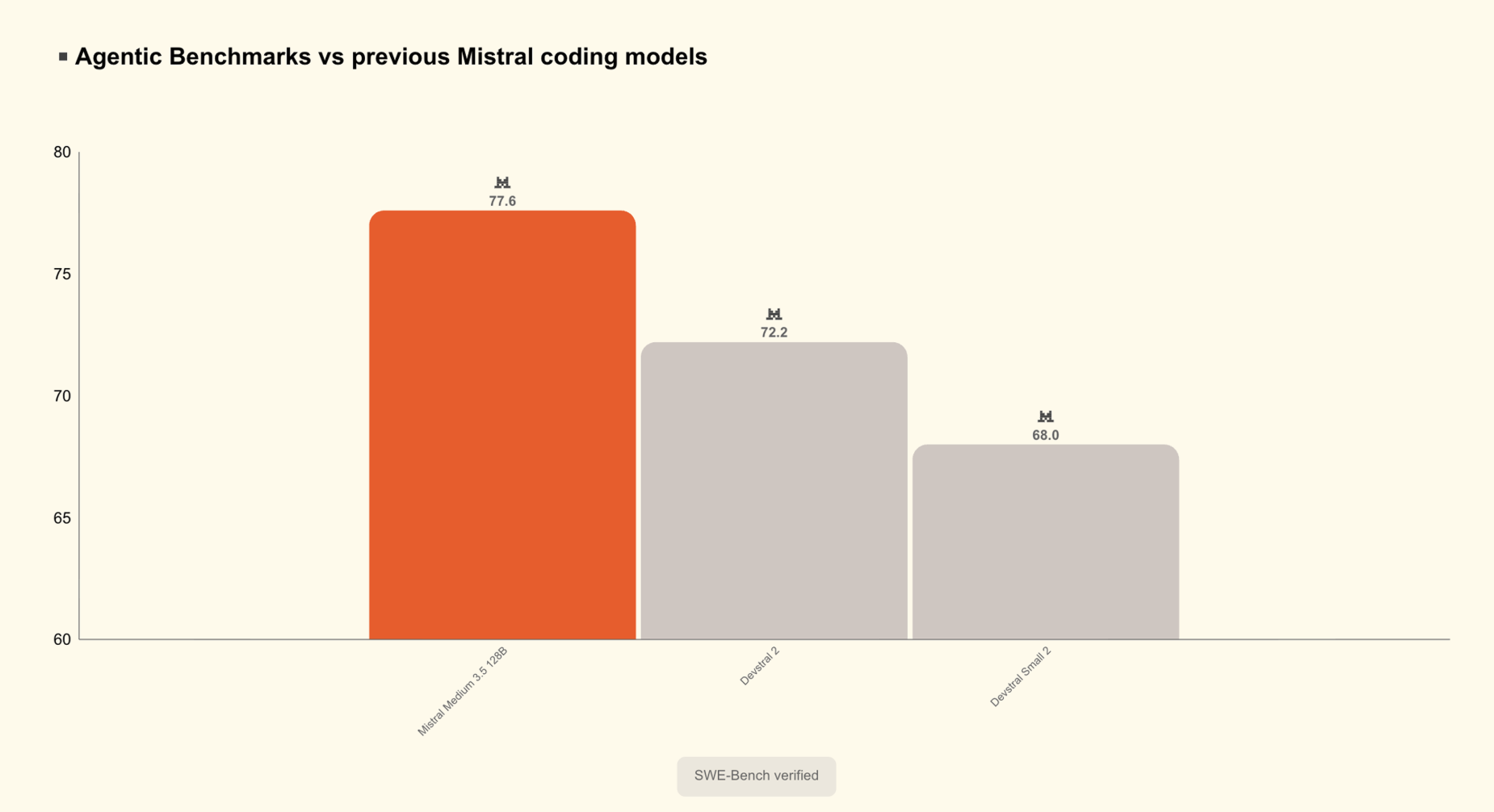
Mistral Medium 3.5 achieved a score of 77.6% on the SWE-Bench Verified benchmark, which measures a model's ability to solve real-world software engineering tasks. This score positions it competitively among leading models, especially for practical coding assignments. The SWE-Bench evaluation focuses on functional correctness of generated code and patches, making it a strong indicator of real-world utility. Mistral's achievement underscores the model's effectiveness when used as the backbone for agents like Vibe.
What makes Mistral’s coding agent ecosystem practical for developers?
Several factors contribute to the practicality of Mistral's ecosystem. First, the ability to run remote sessions in parallel and teleport local sessions reduces friction and speeds up development cycles. Second, the integration with popular development and communication tools (GitHub, Linear, Jira, Sentry, Slack) means minimal disruption to existing workflows. Third, the orchestration via Mistral Studio provides a scalable, production-ready foundation. Finally, using Mistral Medium 3.5 as the default model ensures high-quality outputs. Together, these elements make it a compelling choice for teams looking to augment their development process with AI.